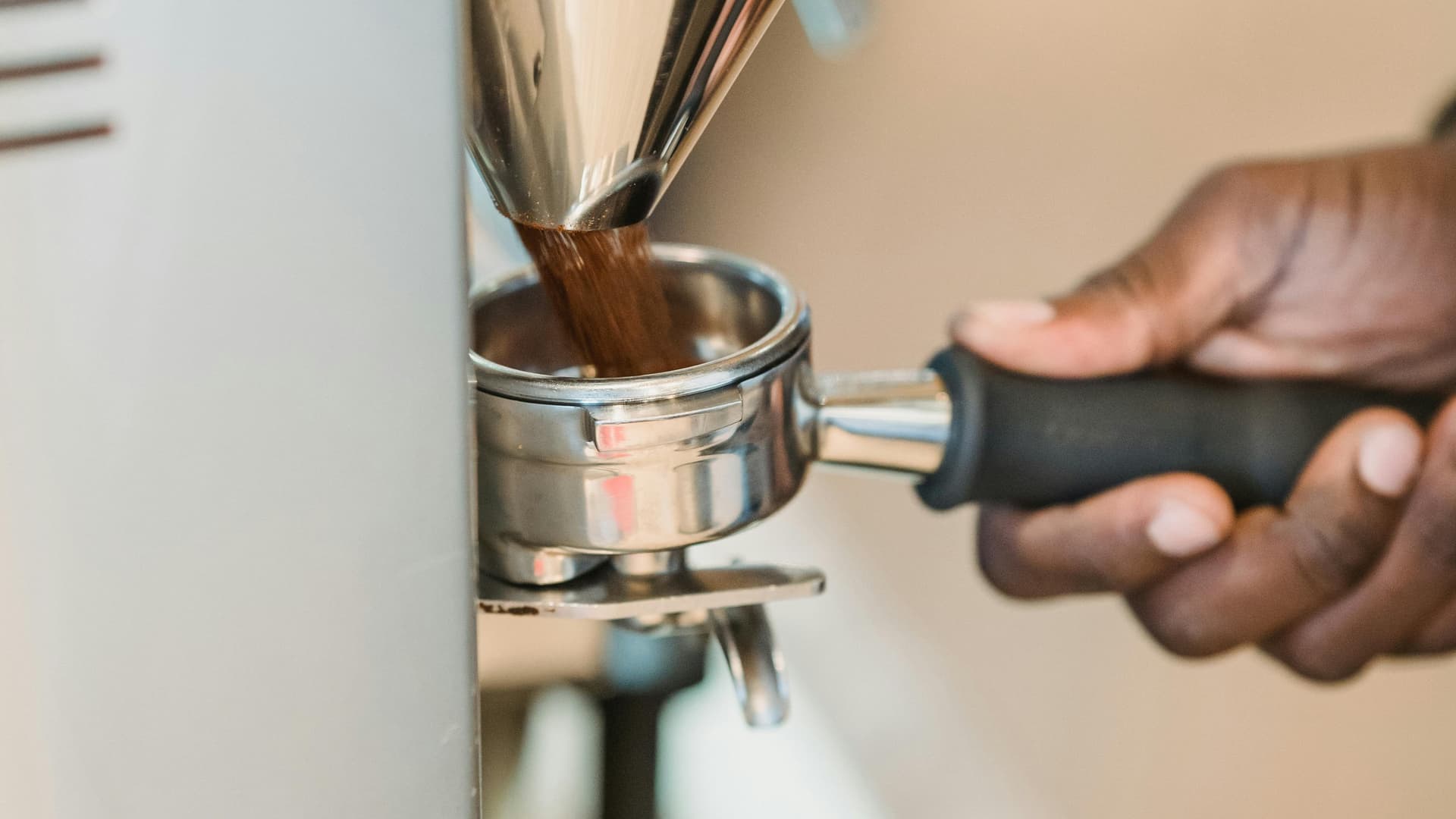
Should You Spend More on Grinder or Machine?
Spend More On: Your grinder matters more than your machine. Split 40-50% on grinder. £200 grinder + £300 machine beats £400 machine + budget grinder.

Obsessive researcher. Helping you skip the 40-hour rabbit hole.
Not sure which setup is right for you?
Take Our QuizThe conventional wisdom — spend more on the grinder, is correct, and the physics are unambiguous. Espresso extraction is sensitive to particle size distribution. If your grinder produces inconsistent particles, some will over-extract and some will under-extract within the same 25-second shot. No machine can fix that. A capable grinder paired with a modest machine will consistently outperform an expensive machine paired with a budget grinder.
The nuance is in what "capable" actually means at different price points, and where the machine becomes the bottleneck once you have a good grinder.
*We earn a small commission from products purchased via our affiliate links, at no extra cost to you. This helps support our independent testing and reviews. Thank you.*
Quick picks
Where to Spend Your Budget
| Allocation | Grinder | Machine | Shot Quality | Best For | Our Verdict |
|---|---|---|---|---|---|
| 50/50 split | £150 | £150 | Poor (weak machine) | Nobody | Avoid |
| 40% machine / 60% grinder | £120 | £180 | Decent | Budget-first buyers | Acceptable |
| 60% grinder / 40% machine | £180 | £120 | Good | Smart budget buyers | Recommended |
| 70% grinder / 30% machine | £210 | £90 | Very good | Enthusiast beginners | Best value |
| Any split with bad grinder | Any | Any | Poor | Nobody | Upgrade grinder first |
**Why grind quality dominates espresso quality**
Espresso extraction is unforgiving. You're forcing pressurised water through finely ground coffee in about 25-30 seconds. The water finds the path of least resistance, which means it flows fastest through areas where the grind is coarser and slowest through areas where it's finer.
When your grinder produces inconsistent particle sizes, some coffee is over-extracted (too much contact time, bitter flavours) while other coffee is under-extracted (too little contact time, sour flavours) within the same shot. You taste both problems simultaneously. No amount of temperature stability or pressure consistency from your machine can fix this, because the fundamental issue is physical: uneven coffee particles.
A cheap blade grinder or a basic burr grinder produces what looks like coffee grounds but is actually a mix of powder, fine particles, and coarse chunks. The powder clogs and over-extracts. The chunks under-extract. Your shot tastes simultaneously bitter and sour, and no dialling-in can fix it because the problem recreates itself with every grind.
A quality grinder with precision burrs produces particles within a narrow size range. The water flows evenly through the coffee bed. Every particle extracts similarly. Your shot tastes balanced, and when something's wrong, adjusting one variable actually fixes it rather than creating new problems.
The machine's job is simpler: heat water to a consistent temperature and push it through the coffee at stable pressure. Modern machines at virtually every price point accomplish this adequately. A £300 machine maintains temperature within acceptable bounds. A £1,500 machine maintains it more precisely, but the difference in cup quality is minimal compared to the difference between grinders.
The ideal budget allocation
The general rule is 40-50% of your total budget on the grinder. This sounds aggressive until you understand that grinders and machines have different price-to-performance curves.
Machine improvements above £500 typically deliver diminishing returns. The jump from £300 to £500 is noticeable. The jump from £500 to £1,000 is smaller. The jump from £1,000 to £2,000 is mainly convenience features rather than shot quality.
Grinder improvements continue to matter across a wider range. The jump from £50 to £150 is dramatic. The jump from £150 to £300 is still significant. Even the jump from £300 to £500 delivers meaningful improvement in grind consistency.
This means overspending on grinder and underspending on machine typically produces better results than the reverse. For a complete starter setup that gets this balance right, see our entry-level espresso setup guide.
Recommended combinations by total budget
At £400 total, pair the Sage Bambino with a Timemore C3 ESP PRO manual grinder. This setup makes excellent espresso. *(Prices when reviewed: Bambino approx £299, Timemore approx £100 | Check Bambino | Check Timemore)* You get stable temperature and adequate pressure from the Bambino, while the manual grinder delivers grind consistency matching electric grinders costing twice as much. The trade-off is 30-45 seconds of hand grinding per drink.
At £500 total, the Sage Bambino plus the Baratza Encore ESP gives you electric grinding convenience. *(Prices when reviewed: Bambino approx £299, Encore ESP approx £180 | Check Bambino | Check Encore ESP)* The Encore ESP is specifically designed for espresso with fine adjustment steps in the espresso range. This is the entry point for electric grinding that actually works.
At £650 total, the Gaggia Classic Pro plus a 1Zpresso J-Ultra combines a legendary machine with a capable manual grinder. *(Prices when reviewed: Gaggia approx £449, 1Zpresso approx £180 | Check Gaggia | Check 1Zpresso)* The Gaggia lasts decades with massive modification potential, while the JX-Pro delivers grind quality matching electric grinders in the £300+ range.
At £800 total, stretch to the Gaggia Classic Pro plus the Sage Smart Grinder Pro. *(Smart Grinder Pro price when reviewed: approx £200 | View on Amazon)* This is where electric grinding becomes genuinely good. The Smart Grinder Pro has enough adjustment steps to dial in properly and produces consistent enough grinds to showcase what the Gaggia can do.
At £1,000+ total, consider the Eureka Mignon Notte or Specialita paired with your machine of choice. At this level, you're entering proper prosumer territory where both machine and grinder are no longer limiting factors.
Where machines matter and where they don't
Machines matter more for milk drinks than straight espresso. Steam power, steam recovery time, and boiler capacity affect your ability to texture milk properly. A budget machine with weak steam can make excellent espresso but produces disappointing cappuccinos.
Machines matter more for workflow than shot quality. Dual boiler machines let you steam while brewing. Heat exchangers provide continuous steam without waiting. Single boilers require switching between modes. If you're making multiple milk drinks in sequence, machine design affects how long it takes.
Machines matter less for shot quality within the £300-800 range than most people assume. A Sage Bambino extracts espresso as well as machines costing twice as much. The differences are in convenience features, not extraction capability.
Temperature stability is the main machine variable that affects shot quality, and most modern machines maintain acceptable temperature. Traditional machines like the Gaggia Classic have some temperature surf requirements, but this is manageable technique, not a fundamental limitation.
Where grinders matter everywhere
Grind consistency affects every shot. There's no technique to compensate for inconsistent particle size. Either your grinder produces uniform particles or it doesn't, and this shows in every cup.
Adjustment precision determines whether you can dial in properly. Stepless grinders with fine adjustment capability let you find the exact setting. Stepped grinders with large increments mean you're always slightly off in one direction or another.
Retention affects workflow and freshness. Grinders that retain coffee from previous doses mix old stale grounds with fresh ones. Single-dose grinders minimise this but cost more.
Burr quality affects flavour clarity. Better burrs produce more defined flavours. Budget burrs muddy the distinction between origin characteristics.
The upgrade path reality
Most home espresso enthusiasts upgrade grinders more often than machines. A quality machine like the Gaggia Classic Pro can last 15-20 years with basic maintenance. You'll likely want a better grinder within 1-2 years as your palate develops. If your total budget is tight, read our under £200 espresso guide before buying anything.
This argues for spending conservatively on your first grinder and planning to upgrade. Start with a Timemore C3 ESP PRO or Baratza Encore ESP, learn what good espresso tastes like, then upgrade once you understand what you're looking for.
Alternatively, spend more on grinder initially and skip the upgrade cycle. A Eureka Mignon or Niche Zero might satisfy you for years, eliminating the waste of intermediate purchases. Read our Niche Zero review if you're considering the premium route.
How to allocate your specific budget
The rough guideline is 25-35% on grinder and the rest on machine, but this shifts depending on your total budget. At lower budgets, manual grinders let you allocate more toward the machine while still getting excellent grind quality. At higher budgets, the grinder percentage can increase because you've already covered machine basics.
With £400 total, spending around £100-120 on a manual grinder like the Timemore C3 ESP PRO leaves £280-300 for a capable machine like the Sage Bambino. This is manual grinder territory, but the results are excellent.
With £500 total, you can stretch to £150-180 on grinder, which opens up entry-level electric options like the Baratza Encore ESP or premium manual grinders. The remaining £320-350 still gets you a solid machine.
With £700 total, allocating £200-250 on grinder puts you in serious territory. Pair that with a £450-500 machine like the Gaggia Classic Pro and you have a setup that will satisfy you for years.
With £1,000 total, spending £300-400 on grinder gets you prosumer grinding capability. The remaining £600-700 buys a machine that's no longer a limiting factor.
Above £1,500 total, both components can be excellent. Spend £500+ on grinder and put the remainder into whatever machine features matter to you.
My honest recommendation
If you're starting espresso and unsure how deep you'll go, buy a Sage Bambino and a Timemore C3 ESP PRO. Total around £400. You'll make excellent espresso, learn whether you enjoy the hobby, and if you want to upgrade later, you'll know exactly what matters to you.
If you already know espresso is for you and want to skip intermediate steps, buy a Gaggia Classic Pro and the best grinder you can afford after. The Gaggia will last essentially forever. The grinder will determine your shot quality ceiling for years.
Either way, don't underspend on the grinder. That's the single most reliable piece of advice in home espresso.
What to avoid
Don't allocate your budget 70% machine, 30% grinder. This is backwards. You'll hit a quality ceiling fast when the grinder can't grind fine enough or adjust precisely enough. No amount of machine capability compensates for grind inconsistency.
Don't buy a premium machine with the cheapest grinder as a starter "package." Many bundles pair a £500 machine with a £50 blade grinder. The blade grinder will hobble the machine for years. Better to buy a modest machine and good grinder separately.
Don't use "I can't afford both now" as an excuse to start with a bad grinder planning to "upgrade later." Start with a Timemore C3 ESP PRO (£80-100) and a basic £200-300 machine instead. You'll make better coffee immediately and avoid the sunk cost of a bad grinder.
Don't assume all grinders at the same price point are equivalent. A £200 burr grinder designed for espresso beats a £200 blade grinder dramatically. Quality burr design and adjustment precision vary enormously, read the specific recommendations, not just the price point.
Don't upgrade the machine when the grinder is your problem. If you have a DeLonghi Dedica or basic machine with a cheap grinder, buying a Gaggia Classic doesn't solve your real issue. Upgrade the grinder first. The machine probably isn't your bottleneck yet.
Don't believe "machines don't matter for espresso quality." They do, but less than grinders. Within the £300-800 range, machine differences are smaller than most people think. Above £800, differences become more meaningful, but grinder still matters more.
Common questions about grinder vs machine budget
What's the minimum I should spend on a grinder?
Around £80-100 for a capable manual grinder like the Timemore C3 ESP PRO, or £150-180 for an entry-level electric like the Baratza Encore ESP. Below these thresholds, grind consistency drops noticeably and your espresso suffers regardless of your machine.
Why does grinder quality matter more than machine quality?
Physics. Inconsistent grind produces simultaneous over-extraction and under-extraction in the same shot. No machine can fix this. A quality grinder produces uniform particles that extract evenly, and even a modest machine can push water through evenly-ground coffee successfully.
Should I upgrade my grinder or my machine first?
Almost always the grinder. Most people upgrade grinders within 1-2 years as their palate develops, while quality machines like the Gaggia Classic Pro last 15-20 years. Your grinder is likely the limiting factor in your current setup.
Can we use a blade grinder for espresso?
No. Blade grinders produce wildly inconsistent particle sizes that make proper espresso extraction impossible. Even a cheap burr grinder is dramatically better than an expensive blade grinder for espresso.
What if I already own a machine but need a better grinder?
This is the most common scenario, and the answer is straightforward: upgrade the grinder first. If you have a DeLonghi Dedica or similar entry-level machine with the included pressurised basket, a quality grinder will transform the shots you can pull from it. The machine isn't your limiting factor yet. Once your shots are consistently good with a proper grinder, then evaluate whether the machine is now your bottleneck. Most people discover the machine is fine for another year or two once the grinder is sorted.
Does the grinder-first rule ever not apply?
When your machine physically can't do what you need. If you're making milk drinks and the machine has a weak pressurised steam wand that can't texture milk properly, that's a machine problem no grinder fixes. Similarly, if your machine has a significant temperature stability issue (common in older entry-level single boilers), the shots may still be inconsistent even with a great grinder. In those cases, a machine upgrade is justified. But these are specific failure modes, for most home espresso setups, the grinder is still the first bottleneck. If your shots are sour or bitter regardless of grind adjustments, and your machine is at least a halfway decent model, the grinder is almost certainly the issue. A practical test: if you can access a high-quality grinder at a friend's house or a local coffee shop, run your beans through it and pull a shot on your existing machine. If the shot improves dramatically, your grinder is the bottleneck. If it tastes roughly the same, look at the machine.
Not sure how to allocate your budget?
## What to Avoid
Cutting the grinder budget to afford a better machine. This is the single most common mistake in home espresso. The grinder determines particle size; the machine determines the environment those particles extract in. A mediocre grinder produces inconsistent particles that extract unevenly regardless of how good the machine is. A quality grinder with a modest machine extracts cleanly. The reverse does not work. If you can only afford one thing properly, make it the grinder.
Blade grinders as a temporary measure. “I’ll start with the blade grinder while I save for a proper one” is a false economy. Blade grinders chop randomly, producing a mix of fine powder and coarse chunks that extract simultaneously, bitter from the fines, sour from the coarse. The result is not espresso with room for improvement; it’s undrinkable coffee that gives a false impression of what your machine can do. Budget for a burr grinder from day one, even if it’s a hand grinder.
All-in-one machines as a way to skip the grinder decision. Machines like the Sage Barista Express include a built-in grinder, which sounds like it solves the budget problem. It doesn’t. The built-in grinder is constrained by cost and space in a way a standalone grinder isn’t. For the same total budget, separating the machine and grinder always produces better extraction than combining them in one unit. All-in-ones trade extraction quality for convenience.
Assuming grinder price determines grinder quality. Not all expensive grinders are great for espresso, and not all affordable grinders are poor. What matters for espresso is consistent burr alignment, fine enough grind range, and low retention. Some hand grinders under £100 outperform electric grinders at twice the price on these measures. Research the specific grinder’s espresso performance before buying based on price.
The practical threshold: don't underspend the grinder below £80-100 (manual) or £150-160 (electric). Below those figures, grind inconsistency is the dominant problem in your espresso regardless of what machine you have or how carefully you dial in. Above those thresholds, the grinder is no longer your limiting factor, and that changes everything about how quickly you learn.
As an Amazon Associate, we earn from qualifying purchases.
Products Mentioned in This Guide
Find Your Perfect Setup
Answer a few quick questions and get personalised recommendations.
Start the QuizFrequently Asked Questions
Should I spend more on grinder or espresso machine?
Spend more on the grinder. Budget 40-50% of your total setup on the grinder. A £200 grinder with £300 machine beats a £400 machine with budget grinder.
Why does grinder matter more than machine?
Espresso is about extraction. Inconsistent grind = inconsistent extraction = bad shots. Even expensive machines can't fix a bad grind.
What's the minimum to spend on an espresso grinder?
Around £150 for manual (1Zpresso JX-Pro) or £200 for electric (Baratza Encore ESP). Below this, grind quality limits your espresso.
Related Guides
Ready to find your perfect setup?
Our quiz matches you with the right machine, grinder, and accessories.
Take the Quiz - It's FreeNo email required